Belvedere Life FLR Guide
What Is a Female-Led Relationship?
A Female-Led Relationship (FLR) is a consensual relationship structure in which the woman accepts a recognized leadership role while both partners remain committed to mutual respect, open communication, accountability, and shared purpose. Rather than focusing on power, a healthy FLR emphasizes intentional leadership that helps the relationship function with greater clarity, trust, and cooperation.
At its core, an FLR is about creating a partnership where responsibilities, expectations, and decision-making are discussed openly rather than assumed. Every healthy Female-Led Relationship is built on the understanding that both partners freely choose the structure and retain the ability to revisit and refine it as their relationship grows.
Leadership Exists on a Spectrum
One of the most important concepts to understand is that female leadership exists on a spectrum. There is no universal formula that every couple follows, and healthy FLRs can look very different from one relationship to another.
For some couples, female leadership may involve only a few specific areas, such as managing household organization, coordinating family schedules, or guiding financial planning. Other couples may choose a more comprehensive leadership structure in which the woman takes primary responsibility for long-term decision-making while still encouraging discussion, collaboration, and input from her partner.
Some relationships naturally shift between these approaches over time. Career changes, raising children, retirement, health concerns, and personal growth can all influence how leadership is shared. Healthy couples recognize that relationship structures should serve the people within them, not force the people to serve a rigid structure.
There Is No Single “Correct” Model
One of the biggest misconceptions about Female-Led Relationships is the belief that there is only one “right” way to practice them.
In reality, there is no single correct model.
Every couple brings unique personalities, values, communication styles, life experiences, and goals into their relationship. What creates harmony for one couple may not be the best fit for another.
Some couples prefer clearly defined leadership roles with written agreements and regular relationship reviews. Others adopt a more informal approach in which leadership develops naturally through trust, mutual understanding, and shared experience.
Neither approach is inherently better.
The healthiest model is the one that both partners freely choose, understand, and support.
Leadership Is Not About Control
Healthy leadership should never be confused with domination, coercion, or superiority.
Instead, leadership means accepting responsibility for helping the relationship thrive. It includes providing direction when needed, encouraging healthy communication, helping resolve disagreements, and promoting habits that strengthen trust and emotional connection.
Likewise, the devoted partner is not passive or voiceless. A healthy partner contributes ideas, expresses concerns honestly, accepts personal responsibility, and actively participates in building a successful relationship.
Both partners have important roles.
Both partners deserve respect.
Both partners contribute to the health of the relationship.
A Framework Built on Shared Values
Whether leadership is modest or more structured, successful Female-Led Relationships consistently share the same foundational principles:
- Mutual consent
- Open communication
- Trust
- Accountability
- Emotional maturity
- Respect for one another
- Shared goals
- A commitment to continual growth
These principles matter far more than the specific way leadership is organized.
Ultimately, a healthy Female-Led Relationship is not defined by how much authority one partner has. It is defined by how effectively two people work together to build a relationship that reflects their shared values, strengthens their connection, and supports a fulfilling life together.
Why Healthy Female-Led Relationships Are Often Misunderstood
A healthy Female-Led Relationship (FLR) is a consent-based relationship in which the woman accepts a recognized leadership role while both partners maintain mutual respect, communication, accountability, and shared responsibility. Contrary to common myths, healthy FLRs are not abusive, do not diminish men, and are about far more than private intimacy.
10 Common Myths About Female-Led Relationships, Debunked: A Complete Guide to Healthy FLRs
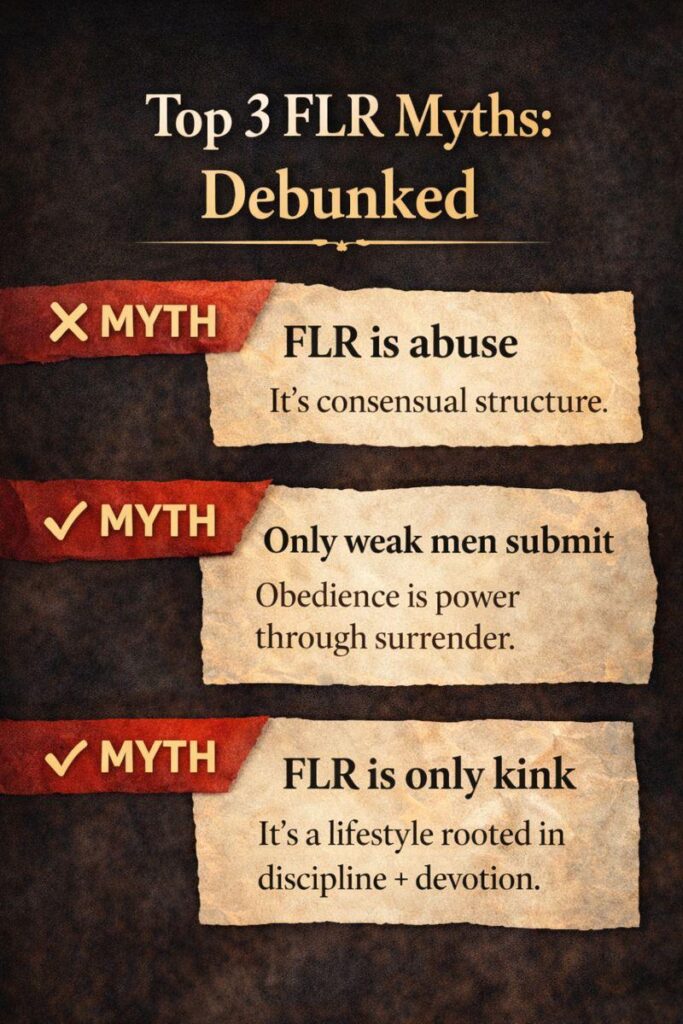
Myth 1
Female-Led Relationships Are Abusive
Reality: Leadership and coercion are fundamentally different.
Myth 2
Only Weak Men Choose Female Leadership
Reality: Receiving trusted leadership requires confidence, communication, and emotional maturity.
Myth 3
FLRs Are Only About Physical Intimacy
Reality: Most healthy FLRs are built through everyday communication, organization, and shared goals.
Myth 4
Women Make Every Decision
Reality: Leadership does not eliminate collaboration.
E
Myth 5
Men Lose Their Independence
Reality: Healthy devotion still includes personal responsibility, friendships, career, hobbies, and individual identity.
Myth 6
FLRs Cannot Be Equal Partnerships
Reality: Leadership and equality describe different aspects of a relationship. Discuss dignity, mutual respect, and shared value.
Myth 7
FLRs Never Change
Reality: Healthy relationship structures evolve with careers, children, health, retirement, and life transitions.
Myth 8
FLRs Are Anti-Men
Reality: Healthy female leadership values and supports both partners. It is not built on resentment or superiority.
Myth 9
Only Certain Personality Types Can Have an FLR
Reality: Successful FLRs depend on communication and compatibility, not personality labels.
Myth 10
There Is One Correct Way to Practice an FLR
Reality: Every couple creates a structure that reflects their own goals, values, strengths, and circumstances.
What Healthy FLRs Have in Common
Cover the core principles:
- Consent
- Trust
- Communication
- Emotional leadership
- Accountability
- Respect
- Adaptability
- Shared purpose
Monthly Relationship Review Checklist
Strong relationships rarely improve by accident.
Whether your relationship follows a traditional structure, shared leadership, or a Female-Led Relationship, taking time to evaluate your partnership together can strengthen communication, reinforce trust, and help identify small concerns before they become larger challenges.
Set aside 20 to 30 minutes once each month. Choose a quiet, distraction-free environment where both partners can speak honestly and listen without interruption. The purpose of this review is not to assign blame. It is to celebrate progress, identify opportunities for growth, and reaffirm your shared commitment.
1. Communication
Discuss how well you’ve communicated during the past month.
Ask yourselves:
- Have we listened to understand rather than simply respond?
- Did either of us avoid important conversations?
- Have we communicated respectfully, even during disagreements?
- Do we both feel heard and valued?
- Is there anything we need to discuss that we’ve been postponing?
Goal: Build openness, honesty, and emotional safety.
2. Trust
Healthy relationships are built on consistent trust.
Ask yourselves:
- Have we kept our commitments?
- Do our actions reflect our words?
- Have we been dependable?
- Has either of us experienced uncertainty or insecurity that needs discussion?
- What strengthened our trust this month?
Goal: Continue building confidence in one another.
3. Leadership & Partnership
If your relationship includes female leadership, review how the structure is serving both partners.
Ask yourselves:
- Is our leadership structure helping us function more effectively?
- Are responsibilities clearly understood?
- Do we feel supported by one another?
- Does either partner feel overwhelmed?
- Should we adjust any responsibilities for the coming month?
Remember that healthy leadership exists to strengthen the relationship, not to diminish either partner.
Goal: Ensure leadership creates clarity rather than confusion.
4. Accountability
Growth requires personal responsibility from both partners.
Ask yourselves:
- Have we followed through on our commitments?
- Have we accepted responsibility when we made mistakes?
- Did we offer sincere apologies when appropriate?
- Have we demonstrated integrity in our daily actions?
- What can each of us improve next month?
Goal: Encourage growth without criticism.
5. Emotional Connection
Relationships flourish when emotional intimacy is intentionally nurtured.
Ask yourselves:
- Have we spent meaningful time together?
- Do we feel emotionally connected?
- Have we shown affection and appreciation regularly?
- Have we supported one another through challenges?
- What moments brought us closer this month?
Goal: Deepen emotional closeness.
6. Shared Goals
A healthy relationship moves in the same direction.
Review your goals together.
Consider:
- Are we making progress toward our shared priorities?
- Have any of our goals changed?
- Are we balancing work, family, finances, and personal growth effectively?
- What should receive greater attention next month?
Goal: Maintain a shared sense of purpose.
7. Appreciation
Never overlook what is going well.
Each partner should answer:
- What is one thing my partner did this month that made me feel loved or supported?
- What quality do I appreciate most about my partner right now?
- Have I expressed my appreciation clearly?
Finish by thanking one another for specific actions rather than offering general compliments.
Goal: Reinforce positive behaviors and strengthen emotional connection.
8. Looking Ahead
Before ending your review, discuss the coming month.
Complete these statements together:
- One thing we want to continue doing is…
- One habit we would like to improve is…
- One challenge we expect to face is…
- One way we can better support one another is…
- One relationship goal for next month is…
Write your answers down and revisit them during your next monthly review.
Frequently Asked Questions
Are Female-Led Relationships healthy?
- Is an FLR abusive?
- Can Christians have an FLR?
- Do women make every decision?
- Can leadership change?
- How do couples start an FLR?
- Is an FLR compatible with marriage?
- What happens if one partner wants to change the structure?
- Are FLRs based on equality?
Belvedere Life Reflection
Healthy leadership exists to strengthen the relationship, create clarity, deepen trust, and encourage mutual growth through consent and communication.
Healthy relationships are not measured by perfection. They are measured by the willingness of two people to communicate honestly, learn continuously, and support one another with respect, trust, and accountability.
Leadership is not about having all the answers. It is about creating an environment where both partners can thrive.
When couples intentionally review their relationship on a regular basis, they create opportunities to celebrate progress, strengthen their connection, and continue building the life they want together.
Small, consistent conversations often produce the greatest long-term growth.
Continue Your Belvedere Life Journey
Leadership is only one part of building a healthy, intentional Female-Led Relationship.
Continue exploring Belvedere Life:
- What Is a Female-Led Relationship?
https://belvederelife.org/what-is-flr/ - FLR Foundations
https://belvederelife.org/flr-foundations/ - FLR Relationship Structure
https://belvederelife.org/flr-relationship-structure/ - Journal
https://belvederelife.org/journal/ - Shop
https://belvederelife.org/shop/
Further Reading
To explore additional research-informed perspectives on healthy relationships, communication, and emotional connection, consider these resources:
- The Gottman Institute – Research-based guidance on communication, trust, conflict management, and long-term relationship health. https://www.gottman.com/
- American Psychological Association (APA) – Educational resources on healthy relationships, communication, and emotional well-being. https://www.apa.org/topics/relationships
- Greater Good Science Center (UC Berkeley) – Articles and research on trust, gratitude, empathy, compassion, and the science of healthy relationships. https://greatergood.berkeley.edu/topic/relationships